
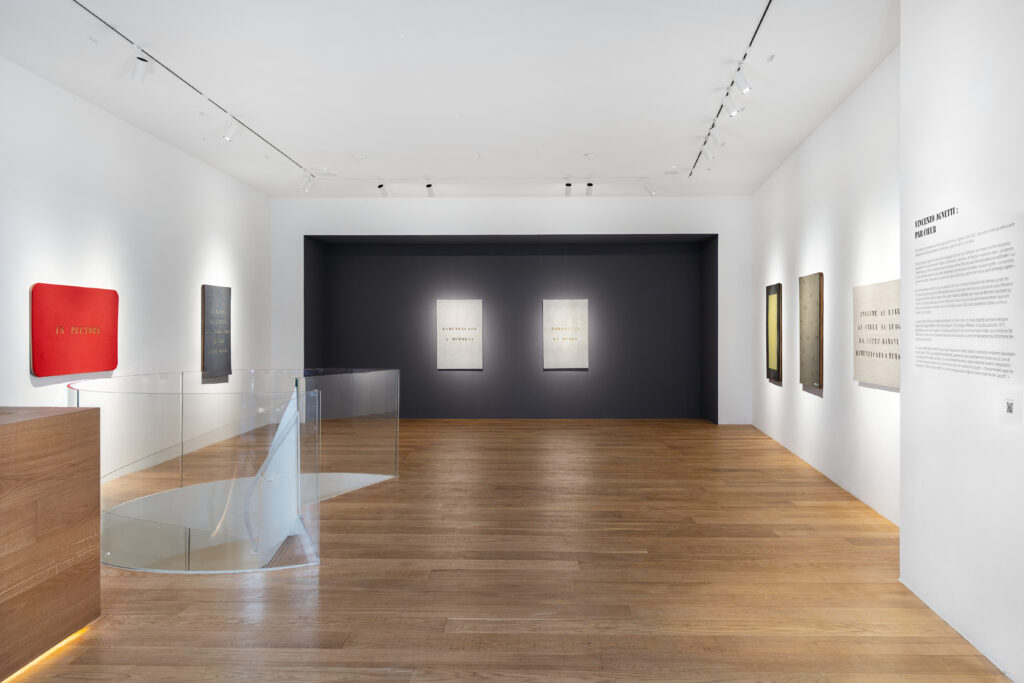


On the occasion of the centenary of Vincenzo Agnetti’s birth, the exhibition par cœur (by heart) is an invitation to rediscover the conceptual and yet theatrical work of a true poet of Italian art.
Agnetti’s practice is centered around language, exploring its fragility, its limits, and its evocative power. The exhibition takes its title from the phrase “Dimenticato a memoria,” meaning “forgotten by heart,” a polysemous oxymoron that the artist explores in several series of works, both pictorial and sculptural. “Culture is about learning to forget, just like when we eat,” Agnetti explains. “More or less well manipulated, food gives us its flavor, which we quickly forget in favor of the energy we ingest.”
The same paradox is displayed across a number of felt canvases, all identical in size, bearing stencilled inscriptions. They form part of the Feltri series, which are among the most literary and poetic of the artist’s works. In them, Agnetti subverts the visual codes of the lapidarium, by replacing the cold surface of the marble with the warmth of felt, on which he affixes his aphorisms in capital letters. Each of these works, produced from the late 1960s onwards, were considered by the artist to be either a portrait or a landscape.
Urban spaces and dwellings are a major theme for the artist, as seen in the work Tre villaggi differenti – Non c’è più nessuno (Three Different Villages -There Is No One Left, 1977), on view in the gallery’s lower level. With white letters traced on a black ground, the polyptych addresses the abandonment of villages and communal life in favor of the anonymity and conformism of large urban centers.